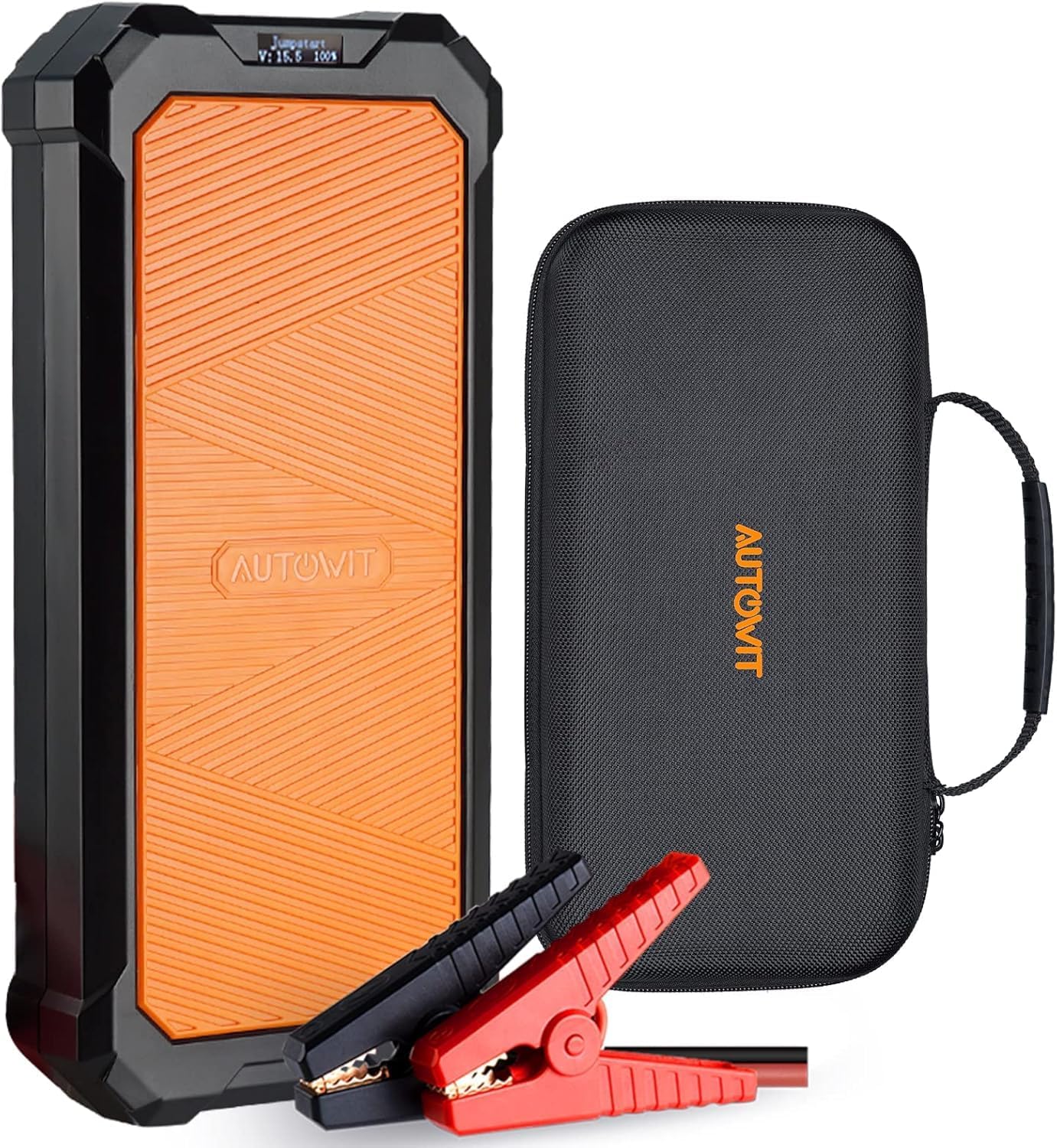
⚡ Never get stranded again—jumpstart your freedom with Autowit SuperCap 2!
The Autowit SuperCap 2 is a cutting-edge 12V batteryless portable jump starter featuring supercapacitor technology for instant, maintenance-free power. It delivers a powerful 800A peak current capable of jumpstarting most gasoline engines up to 7.0L and diesel engines up to 4.0L. Designed for extreme conditions (-40°C to 70°C), it offers over 100,000 reliable jump starts with ultra-safe protections against sparks and electrical faults. Compact and lightweight, it’s the perfect emergency tool for professionals and adventurers who demand readiness without the hassle of regular charging.


| ASIN | B086L29DL9 |
| Amperage | 800 Amps |
| Assembly Required | No |
| Brand | autowit |
| Country of Origin | USA |
| Customer Reviews | 4.4 4.4 out of 5 stars (2,427) |
| Date First Available | 14 June 2020 |
| Item Weight | 907 g |
| Item part number | autowit |
| Manufacturer | Autowit |
| Manufacturer Part Number | autowit |
| Model | ZN0140B |
| Peak Output Current | 800 Amps |
| Product Dimensions | 11.5D x 26.5W x 4.5H Centimeters |
J**N
Good solid build, draws it's power from the flat battery. So if your battery goes flat and no one else is around it could be a live saver.
K**E
I thought I would own this item for a year or more before I needed it, but less than 3 days after it arrived, I found my Prius's 12V battery was too low. I got lots of info on the dashboard, but it refused to start. I'm lucky that my 2020 Prius e-AWD has the battery right up front in the engine compartment, like any other car. (My older one had the 12V battery hiding deep under the cargo compartment, behind the rear seat. That location would have made the Autowit even more convenient, compared to stretching jumper cables from another car.) I removed the Autowit and the main booster cable set from the zippered case. The other items in there are just for charging from another source if my car battery is really far gone. A flexible rubber cover protects all the ports and the power button on the Autowit. The blue plug that fits into the side of the booster is marked + and - to match markings on the unit, and the plug is shaped so it only fits one way. I didn't have to press any switch; as soon as I connected to the battery (red to red and black to black, like any other jumper cables) the unit beeped and began charging from the car battery. The display in the top edge of the front of the booster is very small, but crystal-clear and steady. I had to slow down my camera shutter to get it to show the whole display - the the naked eye it isn't blurred at all. The Prius hybrid has a much smaller 12V battery than most cars, since it only needs to fire up a small gas engine. Mine was down to 9.8 volts, low enough for the car to refuse to attempt to drive. I didn't time how long it took to fully charge the Autowit's capacitor. It seemed like forever, but was probably 8 - 10 minutes. That little display counted up 1% at a time, while it reported the battery voltage dropping slowly to 8.0V. Having that display makes it obvious that I'm waiting for it to charge, and that it's going fine. At 100% the booster beeped. The beep is so quiet (to my 70 year old ears) that I didn't try to hear the long beep that tells me the 10-second timer is up. After the "ready" beep I pressed the small red button to get ready to start (the only button on the unit), and I just counted 10 seconds while walking around to the door and sitting, before starting the car normally. And it worked! BUT THE PRIUS STARTED THE ELECTRIC DRIVE SYSTEM ONLY. The dashboard showed the car was up and running, but it was silent - it hadn't started the gas engine. I pressed the gas pedal to force the car to start the gas engine (still in Park), and it fired up and began charging all the electrical stuff. After a few seconds of running I got out and went back to the Autowit. That little display told me the car battery was now being charged at 13.8V, exactly what you expect in any 12V car system. I have AAA, and calling for a jump start would have been free, but I would have waited most of an hour at best to see my rescuer. I have a battery thing that provides 110V AC and 12V DC, but it's too small to provide the big, sudden current needed to start a car. It would have blown a fuse. I could buy a bigger battery-based jump starter, but those are big & heavy, and they need to be kept charged if their going to be any use. Maybe plug it in overnight once a month. Just fine if you start dead cars for a living, like the AAA guy, but if I never used mine, I'd forget, and when I needed it a year later, it would be dead. This Autowit is built to not need charging until it's needed, and then it charges itself off your low battery. (That's not some new miracle electronic circuit. Voltage multipliers have been around for decades. This is a perfect application for it.) If my car battery was so dead that it couldn't charge the Autowit, I could still use that battery power unit to charge my Autowit, or even my power bank for recharging my smartphone. That would have been very slow, but could save me out on some logging road, far from cell service. And I can feel better about helping others with dead batteries. Toyota warns that the Prius has thousands of dollars worth of computers controlling the engine, and connecting it to some old beater with a dead battery might kill my car, resulting in a very expensive repair after getting it towed. But I can quickly charge the Autowit from my running car, disconnect it from my battery, and carry it over the the "victim" car for a quick & easy start, without ever endangering my car with electrical noise from the other. I still need to learn why my car battery got so weak. Probably my dash cam system constantly recording while the car is parked. (VanTrue N4 3-channel system with optional GPS camera mount) Or maybe Toyota's latest software update is causing the car's computers to drain power - seems less likely. But whatever is draining my battery, the Autowit rescued me easily, automatically, and relatively quickly. I'm very glad I bought it, and it's going to live in my car for as long as I have it. *** EDIT *** I was going to contact Autowit about my ling charge time, compared to other reviewers, but decided to test it first, so I would be armed with actual times and photos. I left my car parked and off, and turned on the headlights to drain the battery, testing it with my voltmeter. When it was well below 10V I tried to start the car normally. It refused, giving me the same low voltage message I had seen before. I hooked up the Autowit and watched its display of battery voltage and capacitor charge %. Starting from 17% charge (residual from previous use, I guess), it reached 100% in about 3.5 minutes, much better than my first experience. I pressed the button on the unit, got into my car while I counted 10 seconds, and started the car. Perfect. Again, it came to life in Electric mode, so I pressed on the gas (still in Park) to force it to start the engine. I let it run while I got out and disconnected the Autowit, closed the hood, and went on my errands. Another benefit: I never saw any spark when I connected or disconnected the cables to my battery, both times that I used it. Using standard jumper cables and another car is a bit scary, because you sometimes generate big sparks when the cables touch the battery poles. Since a dying car battery often vents hydrogen gas, that's scary. The hydrogen can burn, and it it burns inside the battery, it can explode. That's not common, but it can happen, and can burn your skin, eyes, and clothes with flying sulphuric acid. To avoid that I learned early to hook up the + (red) side first, then connect the - (black) clamp to some heavy metal bracket on the engine. It's always the second connection that will spark, at either car, and making that second connection on some part far from the battery can save you from an awful mess. But that's with normal jumper cables. I never saw even a tiny spark from the Autowit cables, while connecting, or removing them.
D**X
Funktioniert klasse,haben einen 2.0 Liter Dieselmotor 5x problemlos gestartet bekommen
P**B
Slower to charge on usb than advertised
B**R
Hat meinen alten Diesel gestartet. Finde die Möglichkeit mit 5v Kabel zu laden auch sehr praktisch. Langlebige Kondensatortechnologie!
Trustpilot
1 month ago
3 weeks ago